
How to start collecting · Part 3 of 8
Blog · · 6 min read
How to start collecting, part 3: how to read a slab
The cert number is the card's identity with its grader. Here is what each grader prints, what the QR code opens, what a lookup returns, and the population number that moves the price.
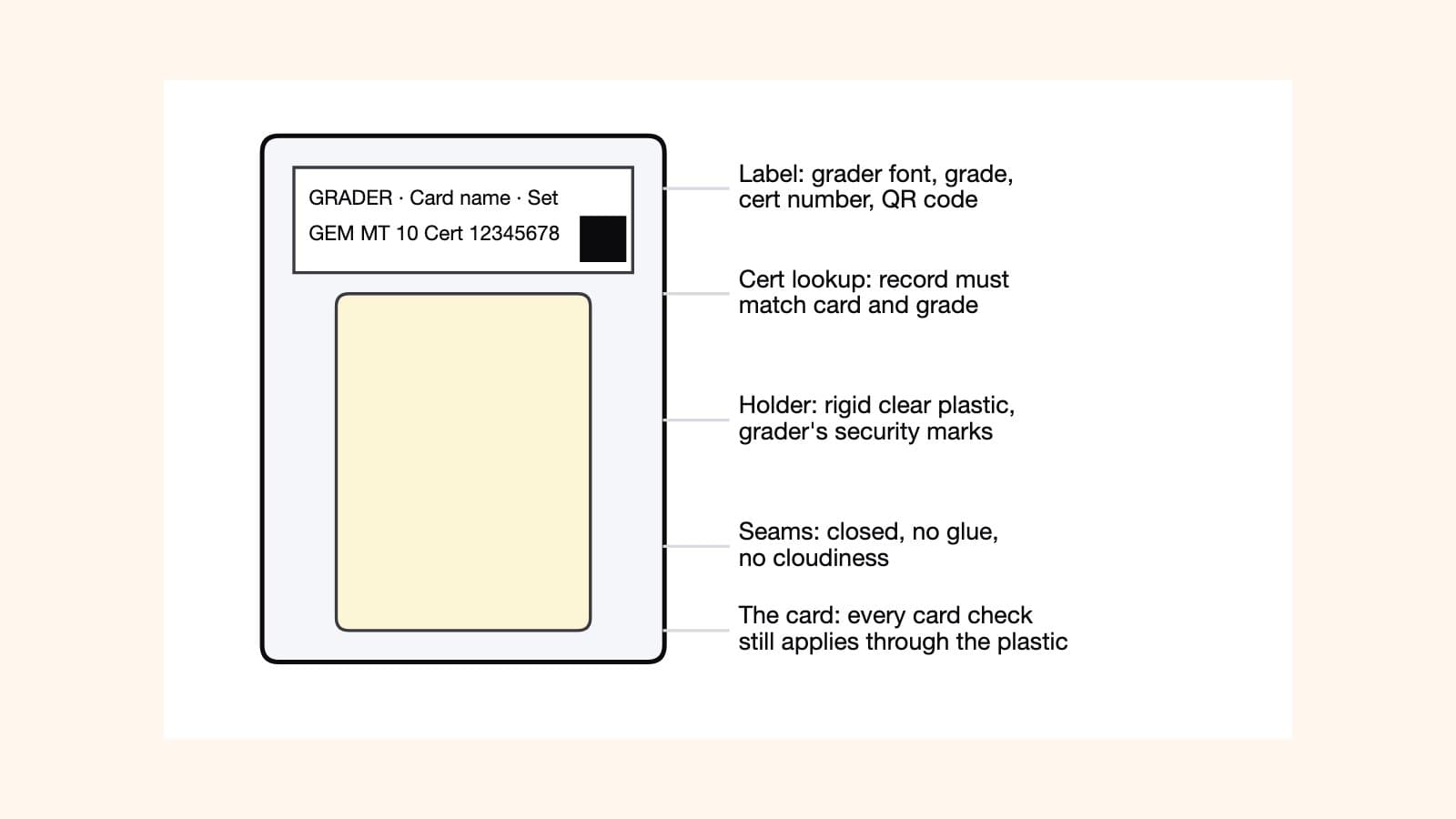
Every slab carries a certification number on the label. That number is what you check, because a label can be copied but the grader's registry cannot. Get in the habit of looking it up before you pay and again when the slab arrives.
The formats
- PSA: 7 to 10 digits. Modern labels carry a QR code that opens the cert page at psacard.com.
- BGS (Beckett): numeric, with four subgrades on the label.
- CGC Cards: 10 digits on current labels, 7 to 8 on older ones. The QR code opens the card's record in CGC's cert lookup.
- SGC: 7 digits, or 7 digits, a dash, and 3 more on green and white labels.
- TAG: one letter and seven digits. The QR code opens the card's DIG report at tagd.co.
- PCGS: 7 to 8 digits for coins and banknotes.
What a lookup shows
At minimum, the item's description and grade. PSA and PCGS add the variety, the label type, and images; PCGS adds its price guide; TAG adds subgrades and population; CGC's comics labels show a fair market value. If the description, grade, or images disagree with the slab in your hand, walk away. In SlabX, the Verify screen does this for you: scan the label's QR code or type the cert, and the app checks the registry where the grader publishes one and marks the item verified only when the registry confirms it.
Population
A population report is the grader's count of how many copies it has certified at each grade. It is the second number that moves a price, after the grade itself. Read three lines: total population, population at this grade, and population higher. A 9 with zero 10s above it is a different asset from a 9 with three hundred. Two cautions: cracked and resubmitted cards inflate counts, and reports lag reality after a price spike sends a wave of submissions. TAG publishes population on every report, PCGS returns it through its API, CGC shows it in its lookups, and PSA's public API returns the population fields empty, so SlabX shows PSA population only when PSA provides it.
Fake slabs
Counterfeit PSA holders exist. Checks that collectors and grader guides describe: the cert lookup must return the same card; newer PSA cases show the PSA name molded into the plastic and specific UV-reactive marks; the sonic weld seam should be even; label fonts and spacing should match a known genuine slab. None of this replaces the registry check, which is why it comes first.
Do this week
- Look up three certs from listings you are watching. Note whether the registry matches the photos.
- Find the population at grade for one card you want and write it next to its price.
Next: part 4, buying without getting burned.
Not financial advice. Collectibles are illiquid and can lose value. Prices and grading fees quoted are as published on the dates named and change often.